Table of contents
- Quick Answer
- Definition
- History
- Evolution
- Traditional vs Digital
- Why Businesses Need It
- Benefits & Importance
- How It Works
- Ecosystem
- Marketing Funnel
- Customer Journey
- Channels Overview
- SEO
- Local SEO
- Technical SEO
- On-Page SEO
- Off-Page SEO
- Google Ads
- Meta Ads
- Instagram Marketing
- Facebook Marketing
- LinkedIn Marketing
- YouTube Marketing
- Email & WhatsApp
- Affiliate Marketing
- Influencer Marketing
- Content Marketing
- Performance Marketing
- Analytics
- Conversion Tracking
- AI Marketing
- Prompt Engineering
- AEO
- GEO
- AI Overviews
- Comparisons
- Tools & Software
- Channel Picker
- Future
- Industries
- Job Roles
- Careers & Salary
- How to Learn
- Why Coimbatore?
- Practical Training
- Choosing a Course
- Beginner Mistakes
- Learn at Fulcrum
- Final Summary
- Glossary
- FAQs (107)
What Is Digital Marketing? The Quick Answer
Digital marketing is promoting products, services or brands through online channels, such as Google Search, social media, websites, email, WhatsApp and AI tools, and measuring the results. It covers SEO, paid ads like Google Ads and Meta Ads, content, social media, email and analytics. Its biggest advantage over traditional marketing is that every click, lead and sale can be tracked.
1. Digital marketing = reaching customers online + measuring what works. 2. It has two halves: organic (SEO, content, social posts) and paid (Google Ads, Meta Ads). 3. Analytics connects the two, so you spend more on what works. 4. AI is changing every channel, from how ads are bought to how people search.
This guide explains digital marketing from zero: what it is, how it works, every major channel, the tools professionals use, how AI is changing it and how you can learn it. If you are already thinking about it as a profession, read our companion guide, is digital marketing a good career?
Digital Marketing Definition and Meaning
Digital marketing is the practice of attracting, engaging and converting customers through internet-connected channels and devices, using data to decide where to spend time and money.
Put more simply: if a business uses the internet to find customers, convince them and keep them coming back, that is digital marketing. A bakery in Gandhipuram posting cake photos on Instagram, a pump manufacturer in Coimbatore running Google Ads for "submersible pump dealers", and a college sending WhatsApp reminders about admission dates are all doing digital marketing.
You will also hear terms like online marketing, internet marketing and digital advertising. Online and internet marketing mean the same thing as digital marketing. Digital advertising is narrower: it only means the paid part, such as Google Ads and Meta Ads.
History of Digital Marketing
Digital marketing is younger than most people's parents. Here are the moments that shaped it.
- 1971First emailRay Tomlinson sends the first network email, the ancestor of email marketing.
- 1990sThe World Wide WebBusinesses build their first websites; early search engines appear.
- 1994First clickable banner adA banner ad on the HotWired website marks the start of online advertising.
- 1998Google is foundedSearch becomes the main way people find information, and SEO becomes a skill.
- 2000Google AdWords launchesBusinesses can pay to appear for search keywords. It is now called Google Ads.
- 2004–2010Social media arrivesFacebook (2004), YouTube (2005) and Instagram (2010) change how brands talk to people.
- 2007 onwardsSmartphonesMarketing moves to mobile screens; "mobile-first" becomes the rule.
- 2016India's data revolutionAffordable 4G data after Jio's launch brings hundreds of millions of Indians online, many in smaller towns.
- 2020The pandemic shiftShops, schools and clinics move online fast; Instagram Reels launches in India.
- 2022ChatGPT launchesGenerative AI starts changing how marketers write, design and research.
- 2023Google Analytics 4GA4 fully replaces Universal Analytics, with event-based, privacy-aware tracking.
- 2024 onwardsAI searchGoogle AI Overviews reach India; ChatGPT, Gemini and Perplexity become places people search. AEO and GEO join SEO.
Evolution of Digital Marketing: From Banners to AI
Each era added a new layer rather than replacing the last one. A modern marketer still uses ideas from every stage.
| Era | Main channels | How marketers worked | Still useful today? |
|---|---|---|---|
| Web 1.0 (1990s) | Websites, banners, email | Put information online; buy banner space | Yes: websites and email remain core |
| Search era (2000s) | Google Search, SEO, AdWords | Match keywords to what people search | Yes: search is still a top source of leads |
| Social and mobile (2010s) | Facebook, Instagram, YouTube, apps | Build communities; target by interests | Yes: social is where attention lives |
| AI era (2020s) | AI-driven ads, AI search, short video | Guide AI with goals, data and creatives; check its output | This is now |
Traditional Marketing vs Digital Marketing
Traditional marketing (newspapers, TV, radio, hoardings, pamphlets) still works for some goals, especially local awareness. But digital marketing wins on targeting, cost control and measurement.
| Traditional marketing | Digital marketing | |
|---|---|---|
| Examples | Newspaper ads, TV, radio, hoardings, pamphlets | Google Ads, Instagram, SEO, email, WhatsApp |
| Minimum budget | Usually high | Can start with a few hundred rupees |
| Targeting | Broad: everyone who reads or passes by | Precise: location, age, interests, search intent |
| Measurement | Hard to know who responded | Every click, call and sale can be tracked |
| Changes after launch | Difficult once printed or aired | Edit ads, budgets and pages anytime |
| Two-way communication | One-way | Comments, messages, reviews, chat |
| Speed | Weeks to plan and print | Campaigns can go live the same day |
| Best for | Mass awareness, local events | Leads, sales, targeted awareness, repeat customers |
Most businesses today use both, with digital taking a growing share. Industry reports in 2026 estimate that digital now takes about 64% to 68% of all advertising spend in India.
Why Businesses Need Digital Marketing
India had about 958 million active internet users in 2025, according to the IAMAI-Kantar Internet in India report. Your customers are already online, searching, scrolling and comparing. A business that is invisible there loses customers to competitors who are not.
Benefits and Importance of Digital Marketing
- Reach the exact audience you want, by location, interest or search
- Start small and scale what works
- Track results in real time
- Test ideas quickly and cheaply
- Build long-term free traffic through SEO and content
- Talk directly to customers through comments and messages
- Bring customers back with email, WhatsApp and retargeting
- Platforms and algorithms change often
- Competition for attention is intense
- Poor tracking can waste money
- SEO and content take months to pay off
- Negative reviews and comments are public
- Privacy rules limit some targeting
- Needs regular effort, not a one-time setup
Why it matters so much now: buyer behaviour has changed permanently. Even someone who finally buys in a physical shop usually researched online first. Digital marketing is no longer an "extra"; for most businesses it is where the customer journey begins.
How Digital Marketing Works: Step by Step
Every digital marketing plan, whether for a small shop or a national brand, follows the same basic loop.
- Know the customerWho are they, what problem do they have, where do they spend time online?
- Set a clear goalCalls, form fills, sales, app installs, store visits or followers. One main goal per campaign.
- Choose channelsSearch for people ready to buy; social for discovery; email and WhatsApp for repeat customers.
- Create the offer and contentAds, posts, landing pages and messages that speak to the customer's problem.
- Set up trackingGA4, conversion tracking and call tracking, so you know what worked.
- Launch and measureRun the campaign and watch cost per lead, conversion rate and quality of leads.
- Improve and scaleStop what fails, test new ideas, and move budget to what works.
A dental clinic in Coimbatore wants more appointments. It improves its Google Business Profile (local SEO), runs Google Ads for "dentist near Gandhipuram", tracks calls and form fills, then sends WhatsApp reminders to existing patients. After a month, it sees which source brought the cheapest appointments and shifts budget there.
The Digital Marketing Ecosystem
Think of digital marketing as an ecosystem with the business website at the centre. Every channel sends people to it (or to WhatsApp, a store or an app), and analytics measures it all.
The ecosystem has three types of media, a useful way to classify any activity:
| Type | Meaning | Examples |
|---|---|---|
| Owned | Channels you control | Website, blog, Instagram page, email list, WhatsApp channel |
| Paid | Attention you buy | Google Ads, Meta Ads, YouTube ads, influencer posts |
| Earned | Attention others give you | Reviews, shares, press mentions, backlinks, AI answer citations |
The Digital Marketing Funnel
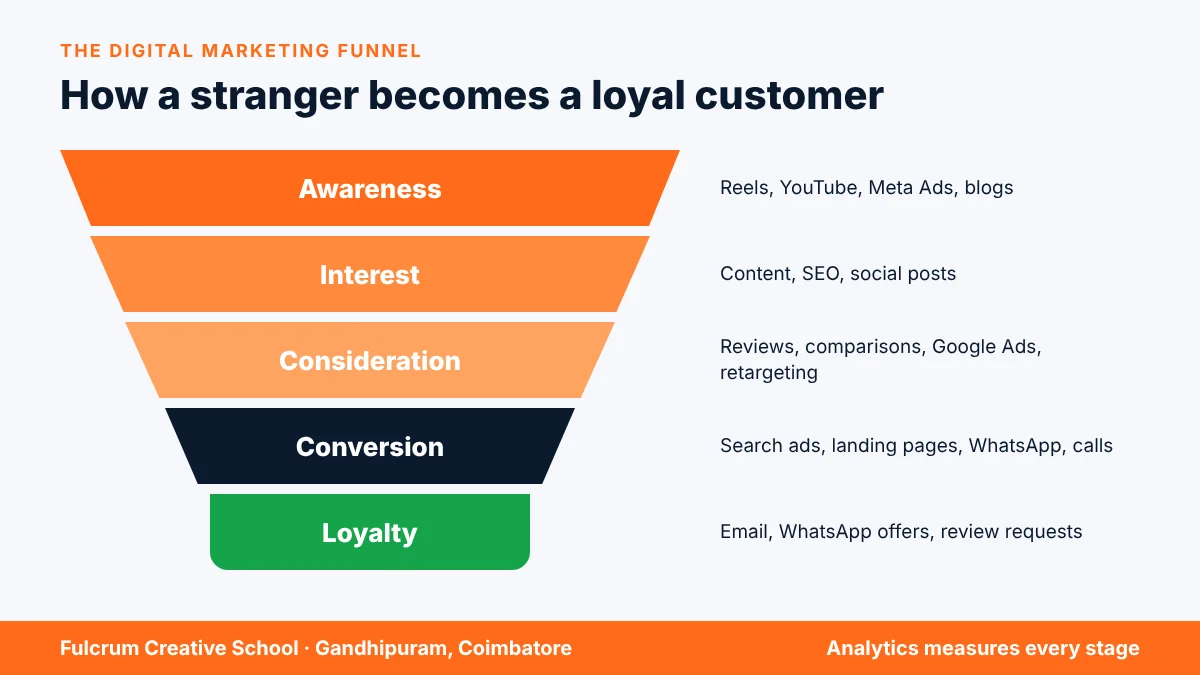
The funnel describes how a stranger becomes a customer. Many people enter at the top; fewer reach the bottom. Each stage needs different content and channels.
| Stage | Customer thinks | Channels | Metric |
|---|---|---|---|
| Awareness | "I have a problem" or "I like this" | Reels, YouTube, Meta Ads, blogs | Reach, views |
| Interest | "Tell me more" | Content, SEO, social posts | Clicks, time on page |
| Consideration | "Which option is best?" | Comparison pages, reviews, Google Ads, retargeting | Leads, enquiries |
| Conversion | "I'm ready to buy" | Search ads, landing pages, WhatsApp, calls | Sales, cost per sale |
| Loyalty | "I'll come back and recommend" | Email, WhatsApp, reviews, offers | Repeat purchase, reviews |
The Customer Journey: A Real Example
The funnel is the theory; the customer journey is what actually happens. Here is a typical journey of a student in Coimbatore choosing a course. Notice how many channels are involved.
- Day 1Sees a reelAn Instagram reel about career options after college appears in her feed (social media, awareness).
- Day 3Searches GoogleShe searches "digital marketing course in Coimbatore" and reads two blog posts (SEO, interest).
- Day 4Asks AIShe asks an AI assistant which skills are in demand; it quotes a guide from one institute (GEO).
- Day 6Sees an ad againA retargeting ad reminds her about a free demo class (Meta Ads, consideration).
- Day 7Checks reviewsShe reads Google reviews and the institute's Google Business Profile (local SEO).
- Day 8Messages on WhatsAppShe asks about batch timings and books a demo (conversion).
- Month 5Recommends itAfter the course, she leaves a review and tells friends (loyalty, earned media).
No single channel "did it". Good digital marketers think about the whole journey, which is why they learn several channels and analytics, not just one tool.
Digital Marketing Channels Explained
Here is every major channel at a glance. The sections below explain each one in detail.
| Channel | Paid or organic | Speed | Best for |
|---|---|---|---|
| SEO | Organic | Slow (months) | Long-term free traffic |
| Local SEO | Organic | Medium | Calls and visits from nearby customers |
| Google Ads | Paid | Fast | People actively searching to buy |
| Meta Ads | Paid | Fast | Discovery, leads, retargeting |
| Instagram and Facebook | Organic and paid | Medium | Brand, community, local audiences |
| Organic and paid | Medium | B2B, hiring, professionals | |
| YouTube | Organic and paid | Medium to slow | Education, trust, product demos |
| Email and WhatsApp | Owned | Fast | Follow-up and repeat sales |
| Content marketing | Organic | Slow | Trust and search visibility |
| Affiliate and influencer | Paid (commission or fee) | Medium | Reaching new audiences through others |
SEO: Search Engine Optimisation
SEO is improving a website so it appears higher in Google's free (organic) results for searches that matter to the business. If you rank on page one for "pump dealers in Coimbatore", you get visitors without paying per click. For a complete beginner explainer, see what SEO is, or our complete SEO guide.
SEO has four main areas. Each has its own guide on our site.
Local SEO
Local SEO helps a business appear when nearby people search, such as "bakery near me" or "dentist in Gandhipuram", especially in the Google Maps "local pack". For shops, clinics, restaurants and institutes, it is often the biggest source of phone calls. Learn more in our local SEO explainer or join a local SEO course in Coimbatore.
- Complete and verify the Google Business Profile: category, hours, photos, services
- Keep the business name, address and phone (NAP) identical everywhere online
- Collect genuine reviews and reply to every one
- List the business on trusted directories (citations)
- Create location-relevant content on the website
Technical SEO
Technical SEO makes sure search engines can find, crawl, understand and index a website, and that visitors get a fast, mobile-friendly experience. It is the foundation: great content will not rank if Google cannot read the page.
- Crawling and indexing: robots.txt, XML sitemaps, canonical tags, no broken links
- Speed and Core Web Vitals: fast loading (LCP), stable layout (CLS), quick response (INP)
- Mobile-first design: Google mainly uses the mobile version of a page
- HTTPS security and clean URL structure
- Structured data (schema): code that tells search engines what the page is about, such as FAQs, courses and reviews
On-Page SEO
On-page SEO is everything you optimise on the page itself so it clearly answers what the searcher wants.
| Element | Good practice |
|---|---|
| Title tag | Main keyword near the start, short enough to read at a glance |
| Meta description | A clear summary that makes people want to click |
| H1 and headings | One H1; H2 and H3 headings that follow a logical order |
| Content | Answer the question early, then go deeper; original, accurate, useful |
| Images | Compressed WebP files with descriptive alt text |
| Internal links | Link to related pages with descriptive anchor text |
| URL | Short, readable, includes the topic |
Off-Page SEO
Off-page SEO builds a website's reputation through signals from elsewhere on the internet. Google treats links and mentions from trusted sites as votes of confidence.
- Backlinks from relevant, trustworthy websites (earned, not bought)
- Reviews on Google and industry sites
- Brand mentions in news, blogs, forums and podcasts
- Digital PR: useful data, guides or stories that others want to cite
- Social signals: content people share and talk about
Buying cheap backlinks in bulk can get a website penalised. Ethical, slow link building wins in the long run.
Google Ads
Google Ads is Google's advertising platform. Businesses bid to show ads when people search specific keywords, watch YouTube or browse partner websites. You usually pay only when someone clicks (pay-per-click, or PPC). See how Google Ads works or our Google Ads course in Coimbatore.
| Campaign | Where ads show | Good for |
|---|---|---|
| Search | Google search results | People ready to buy or enquire |
| Performance Max | Search, YouTube, Display, Maps, Gmail, Discover | AI-driven reach across Google |
| Display | Millions of partner websites and apps | Awareness and retargeting |
| Video (YouTube) | Before and during YouTube videos | Awareness and consideration |
| Shopping | Product listings with images and prices | E-commerce sales |
| Demand Gen | YouTube, Discover, Gmail | Visual ads for new demand |
Meta Ads
Meta Ads are paid ads on Facebook, Instagram, Messenger and WhatsApp, managed in Meta Ads Manager. Unlike Google Ads, which reaches people who are searching, Meta Ads reach people based on location, age, interests and behaviour, often before they know they need you. Read our Meta Ads explainer or see the Meta Ads course in Coimbatore.
- Objectives: awareness, traffic, engagement, leads, app promotion, sales
- Formats: image, video, carousel, Reels ads, Stories ads, lead forms, click-to-WhatsApp
- Advantage+: Meta's AI options that automate audiences, placements and creatives
- Retargeting: show ads to people who visited your website or engaged with your page
Instagram Marketing
Instagram is the main discovery platform for many Indian brands, especially for fashion, food, beauty, education and local services. Organic Instagram marketing means building a following through Reels, carousels, Stories and replies.
- Reels reach new people fastest; the first two seconds decide whether people keep watching
- Carousels are great for tips and step-by-step content that people save
- Stories keep existing followers engaged with polls, questions and offers
- Profile and highlights work like a mini website: clear bio, contact button, highlights for prices and reviews
Social media management is a common first job and freelance service. See our social media marketing course.
Facebook Marketing
Facebook is still widely used in India, especially by audiences above 30, in smaller towns and in local community groups. For many local businesses, a Facebook page with reviews, events and regular posts supports trust, while Facebook ads (run through Meta Ads Manager) bring leads.
- Business page with complete details, reviews and a call or WhatsApp button
- Local groups for community engagement (follow each group's rules)
- Lead ads with instant forms for enquiries
- Events for workshops, launches and offers
LinkedIn Marketing
LinkedIn is the leading platform for B2B (business-to-business) marketing, recruitment and professional branding. Coimbatore's manufacturers, IT companies and consultants use it to reach decision-makers, dealers and job seekers.
- Company page with regular industry updates and case studies
- Founder and employee posts, which often reach more people than company pages
- LinkedIn Ads targeting by job title, industry and company size (higher cost per click, high-quality leads)
- Personal branding for students: a strong profile helps you get hired
YouTube Marketing
YouTube is both a video platform and one of the world's largest search engines. People search it for tutorials, reviews and explanations, which makes it powerful for education, products and services that need demonstration.
- Long videos build deep trust: tutorials, reviews, behind-the-scenes
- Shorts reach new audiences quickly, like Reels
- YouTube SEO: keyword-rich titles, descriptions, chapters and thumbnails
- YouTube ads through Google Ads for awareness and consideration
- Faceless channels (screen recordings, voice-over) work well for teaching skills
Email Marketing and WhatsApp Marketing
Email marketing sends useful messages, offers and updates to people who have agreed to hear from you. It is one of the most cost-effective channels because you own the list: no algorithm decides who sees your message. In India, WhatsApp marketing plays a similar role and is often even more effective for local businesses.
| Message | When it is sent | Purpose |
|---|---|---|
| Welcome series | Right after someone subscribes or enquires | Introduce the brand and build trust |
| Lead follow-up | After a form fill or enquiry | Answer questions, book a demo or visit |
| Abandoned cart | When someone leaves without buying | Recover lost sales |
| Newsletter | Weekly or monthly | Stay top of mind with useful content |
| Re-engagement | When someone has gone quiet | Win back old customers |
Always get permission before messaging people, and make it easy to unsubscribe. Spam damages trust and can get WhatsApp numbers blocked.
Affiliate Marketing
Affiliate marketing is earning a commission for promoting another company's products. The affiliate shares a tracked link (in a blog, YouTube video or Instagram post); when someone buys through it, the affiliate is paid. Amazon Associates and many Indian brand programmes work this way. Businesses like it because they pay only for results. Learn more on our affiliate marketing course page.
Influencer Marketing
Influencer marketing means partnering with creators who have a trusted audience. In India, micro-influencers (smaller creators with engaged local followings) often bring better results for local businesses than celebrity accounts, at a much lower cost.
- Choose creators whose audience matches your customer, not just those with the most followers
- Check engagement quality: real comments, not just likes
- Ask creators to clearly disclose paid partnerships, as Indian advertising guidelines require
- Track results with unique links or discount codes
Content Marketing
Content marketing attracts customers by publishing genuinely useful information: blogs, guides, videos, infographics, case studies and newsletters. Instead of interrupting people with ads, it answers their questions, which builds trust and search visibility. This guide is itself an example of content marketing. See our content marketing course.
- Educational content: how-to guides, explainers, tutorials
- Comparison content: "X vs Y" pages that help buyers decide
- Proof content: case studies, reviews, before-and-after results
- Video content: Reels, Shorts, YouTube tutorials
Performance Marketing
Performance marketing is paid marketing judged strictly on measurable results, such as leads, sales or app installs, rather than reach. Performance marketers work across Google Ads, Meta Ads and marketplaces, constantly testing and moving budget to whatever brings the lowest cost per result.
| Metric | Formula | Example |
|---|---|---|
| CTR (click-through rate) | Clicks ÷ impressions | 50 clicks from 1,000 views = 5% |
| CPC (cost per click) | Spend ÷ clicks | ₹1,000 ÷ 50 clicks = ₹20 |
| Conversion rate | Conversions ÷ clicks | 5 leads from 50 clicks = 10% |
| CPL / CPA | Spend ÷ leads or sales | ₹1,000 ÷ 5 leads = ₹200 per lead |
| ROAS | Revenue ÷ ad spend | ₹4,000 sales from ₹1,000 = 4x |
Analytics, Google Analytics and Google Search Console
Analytics turns marketing from guesswork into decisions. Two free Google tools are used by almost every digital marketer.
- Shows who visits your website and app, from where and what they do
- Tracks events such as button clicks, form fills and purchases
- Reports which channels bring conversions
- Connects to Google Ads for better bidding
- Shows which searches your site appears for, and your clicks and positions
- Reports indexing problems and page experience issues
- Lets you submit sitemaps and request indexing
- Free and essential for every SEO
Conversion Tracking
Conversion tracking records when a visitor completes a valuable action, such as a form fill, phone call, WhatsApp click or purchase, and connects it to the ad or channel that brought them. Without it, you cannot tell which campaign works, and AI-driven ad platforms cannot optimise properly.
- Decide what countsFor a course institute: enquiry form, phone call, WhatsApp click, demo booking.
- Install tagsUse Google Tag Manager to add GA4, Google Ads and Meta Pixel tags without editing code each time.
- Mark conversionsSet those events as conversions (key events) in GA4 and Google Ads.
- TestSubmit a test form and check it appears in each tool.
- OptimiseLet ad platforms bid for conversions, and review lead quality every week.
AI Marketing: ChatGPT, Claude, Gemini and Perplexity
AI marketing means using artificial intelligence to plan, create, run and measure marketing. It already powers ad bidding inside Google and Meta, and generative AI tools now help marketers write, design and research much faster. For a deeper explanation, read what AI marketing is, or see our AI digital marketing course.
| Tool | Made by | Common marketing uses |
|---|---|---|
| ChatGPT | OpenAI | Ad copy drafts, content outlines, captions, brainstorming, image generation |
| Claude | Anthropic | Long-form writing and editing, analysing documents and reports, coding help for landing pages |
| Gemini | Research, working inside Google Workspace, and AI features across Google products | |
| Perplexity | Perplexity AI | Research with cited sources, competitor and trend research |
AI tools can make mistakes and invent facts. Always check figures, claims and brand tone before publishing, and never paste private customer data into public tools.
Prompt Engineering for Marketers
Prompt engineering is the skill of giving AI tools clear instructions so they produce useful output. The difference between a weak and a strong prompt is huge.
Write an ad for my bakery.You are a copywriter for a family bakery in Gandhipuram, Coimbatore. Write 3 Instagram ad captions (under 25 words each) for our eggless birthday cakes. Audience: parents aged 28–40 nearby. Tone: warm, simple English with one Tamil word. Include a call to order on WhatsApp. No exaggerated claims.- Role: tell the AI who it should act as
- Context: business, location, product, audience
- Task: exactly what you want and how many versions
- Constraints: length, tone, language, what to avoid
- Review: edit the output; ask the AI to improve specific parts
AEO: Answer Engine Optimisation
AEO (answer engine optimisation) means structuring content so search features and AI assistants can lift a direct answer from it: featured snippets, voice answers, "People also ask" and AI-generated answers. It builds on SEO but focuses on answering specific questions clearly.
| Traditional SEO | AEO | |
|---|---|---|
| Goal | Rank a page in the list of results | Be the answer that is shown or spoken |
| Focus | Keywords, links, page quality | Questions, clear answers, structure |
| Content style | Full pages on a topic | Short direct answers, then detail |
| Helpful markup | Titles, headings, schema | FAQ format, definitions, lists, tables |
| Success looks like | Clicks from rankings | Visibility in snippets, voice and AI answers |
GEO: Generative Engine Optimisation
GEO (generative engine optimisation) helps AI tools such as ChatGPT, Gemini, Claude and Perplexity understand your brand correctly and mention or cite it when they generate answers. When a student asks an AI "which digital marketing institutes in Coimbatore offer live projects?", GEO is about being accurately included.
| Traditional SEO | GEO | |
|---|---|---|
| Where you appear | Google's list of links | Inside AI-written answers |
| What matters | Rankings, backlinks, relevance | Clear facts, consistent brand information, citations from trusted sources |
| Content | Optimised pages | Original data, definitions, comparisons and expert explanations AI can quote |
| Brand signals | Links to your site | Mentions and reviews across the web, consistent name, address and details |
| Measurement | Search Console clicks and positions | Checking how AI tools describe and cite you |
Google AI Overviews
Google AI Overviews are AI-generated summaries that appear at the top of some Google search results, with links to the websites they draw from. They have been available in India since 2024. For marketers, this means:
- Some simple questions get answered without a click, so top-of-funnel traffic can fall
- Being one of the cited sources brings highly qualified visitors and trust
- Clear, accurate, well-structured content (with real expertise) is more likely to be used
- Local businesses still win clicks through Google Maps, reviews and specific services
Key Comparisons Every Beginner Should Know
SEO vs Google Ads
| SEO | Google Ads | |
|---|---|---|
| Cost per click | Free (but needs time and effort) | Paid per click |
| Speed | Months | Same day |
| Lasts after you stop | Yes, rankings stay for a while | No, traffic stops with the budget |
| Control | Less: Google decides rankings | High: choose keywords, budget, schedule |
| Best for | Long-term growth | Fast leads and testing |
Full comparison: SEO vs Google Ads, which should you learn first?
Google Ads vs Meta Ads
| Google Ads | Meta Ads | |
|---|---|---|
| Reaches people who are… | Searching for something now | Scrolling; not necessarily searching |
| Targeting by | Keywords and intent | Location, interests, behaviour, lookalikes |
| Ad format | Mostly text (search), plus video and display | Images, videos, Reels, carousels |
| Best for | High-intent leads and sales | Discovery, awareness, visual products, lead forms |
Organic vs paid marketing
| Organic | Paid | |
|---|---|---|
| Examples | SEO, social posts, content, email | Google Ads, Meta Ads, sponsored posts |
| Cost | Time and effort | Ad budget plus time |
| Speed | Slow to build | Immediate |
| Trust | Often higher | Lower, but very targeted |
| Best use | Long-term brand and traffic | Quick results, testing, scaling |
SEO vs social media marketing
| SEO | Social media | |
|---|---|---|
| User mindset | Looking for an answer or product | Browsing for entertainment or updates |
| Content life | Months or years | Hours or days |
| Main skill | Research, writing, technical | Creativity, video, community |
| Best for | Steady leads | Brand awareness and loyalty |
Digital Marketing Tools and Software
These are the tools you will meet most often. Most have free versions; you do not need to buy anything to start learning.
Decision tree: which channel should a new business start with?
Try It: Which Channel Fits a Business Goal?
Pick a business type and a goal. The tool suggests where a marketer would usually start. It is a simplified rule of thumb, the kind of first decision you will make in your first week on the job.
1.Type of business
2.Main goal right now
The Future of Digital Marketing
The core of marketing does not change: understand people, make a useful offer, communicate clearly, and measure. Tools change; those fundamentals last.
Industries Using Digital Marketing
Digital Marketing Job Roles and Skill Matrix
Each channel above is also a job. This skill matrix shows which skills matter most for each common role (●●● = essential, ●● = important, ● = helpful).
| Role | SEO | Paid ads | Content | Social | Analytics | AI tools |
|---|---|---|---|---|---|---|
| SEO Executive | ●●● | ● | ●● | ● | ●● | ●● |
| PPC / Google Ads Executive | ● | ●●● | ● | ● | ●●● | ●● |
| Social Media Executive | ● | ●● | ●● | ●●● | ● | ●● |
| Content Marketer | ●● | ● | ●●● | ●● | ● | ●●● |
| Performance Marketer | ● | ●●● | ● | ●● | ●●● | ●● |
| Digital Marketing Manager | ●● | ●● | ●● | ●● | ●●● | ●● |
For salaries, a full list of 12 roles and what a typical day looks like, read is digital marketing a good career?
Career Opportunities and Salary
Digital marketing skills open three paths: a job, freelancing, or growing a business. Entry-level digital marketing executives in Coimbatore are commonly offered ₹15,000 to ₹25,000 a month, and pay grows with proven results. For detailed, sourced figures, see digital marketing salary in Coimbatore and the salary section of our career guide.
Freelancer vs agency job
| Freelancer | Agency job | |
|---|---|---|
| Income | Varies with clients; can grow beyond a salary | Fixed monthly salary |
| Freedom | Choose clients, hours and location | Set hours and team priorities |
| Learning | Self-driven | Fast, with seniors and many clients |
| Risk | Irregular income at the start | Lower |
| Extra skills needed | Sales, pricing, client handling | Teamwork, deadlines |
| Best for | People with a portfolio and self-discipline | Freshers building experience |
Agency careers
Digital agencies serve many clients at once. Freshers learn quickly because they touch several industries and channels. Common agency roles include account executive, SEO executive, PPC executive, content writer, designer and social media executive.
Business opportunities
Digital marketing is also a business skill. Shop owners, home bakers, boutique owners, consultants and manufacturers use it to grow without depending fully on agencies. Many trained marketers eventually start their own agency after building a client base as freelancers.
How to Learn Digital Marketing: A Learning Roadmap
Here is a practical order that works for most beginners, whether you learn alone or in a course. For a full step-by-step plan, see how to become a digital marketer and the digital marketing career roadmap.
- Weeks 1–2FoundationsMarketing basics, funnels, customer journeys, how websites work.
- Weeks 3–5SEO, AEO & GEOKeywords, on-page, technical basics, Google Business Profile, Search Console.
- Weeks 6–7Google AdsSearch campaigns, Performance Max, conversion tracking.
- Weeks 8–9Social & Meta AdsContent calendars, Reels, audiences, lead forms.
- Weeks 10–11Content, email & WhatsAppLanding pages, blogs, automated follow-ups.
- Week 12AI toolsPrompting, AI creatives, AI research, checking AI output.
- Weeks 13–14AnalyticsGA4, Tag Manager, Looker Studio dashboards.
- Weeks 15–16Portfolio & careerCase studies, certifications, interview practice, freelancing basics.
Beginner checklist
- Explore Google's free GA4 demo account to see real reports
- Complete one free Google Skillshop course
- Optimise a real Google Business Profile for a relative or friend
- Start a small niche Instagram page and post 10 times
- Write one blog post with AI help, then edit it yourself
- Run a ₹300–₹500 test ad (or practise in a course's live campaign)
Why Learn Digital Marketing in Coimbatore?
Coimbatore is one of Tamil Nadu's major industrial and business cities, with neighbouring Tiruppur a global knitwear hub. Textile exporters, pump and motor manufacturers, hospitals, colleges, jewellers, restaurants and retailers across the region are moving their marketing online, and most of them need trained people.
- Real clients nearby: thousands of small and medium businesses need Google, Instagram, WhatsApp and local SEO help
- Agencies and IT companies: a growing number of agencies, IT firms and startups hire digital marketers
- Affordable to learn: lower living costs than Chennai or Bengaluru while you build skills
- Tamil and English: marketers who write well in both are valuable to local brands
- Remote-ready: build skills here, serve clients anywhere
Looking for a digital marketing course in Coimbatore? Compare options with our guide to the best digital marketing course in Coimbatore, and check digital marketing course fees in Coimbatore.
Why Practical Training Matters
You cannot learn to swim from a book, and you cannot learn digital marketing from videos alone. Real skill comes from running campaigns with real budgets, real tracking and real customers, then learning from what happens.
- Knows where buttons are
- Certificates, no case studies
- Struggles with live problems
- Memorised interview answers
- Has run real campaigns
- Portfolio with numbers
- Can fix tracking and budget issues
- Explains own work confidently
Choosing the Right Digital Marketing Course
Use this checklist when comparing any digital marketing institute in Coimbatore or online.
- Live projects: will you run real Google Ads and Meta Ads campaigns with tracking?
- Current syllabus: does it include AEO, GEO, GA4 and AI tools, updated this year?
- Trainers: do they practise digital marketing, not only teach it?
- Portfolio outcome: will you finish with case studies you can show employers?
- Batch size and support: can you get individual feedback?
- Placement support: what exactly is offered, and is it described honestly (support, not a guarantee)?
- Language and mode: classroom, online, Tamil and English options
- Demo class: can you attend one before paying?
- Reviews: what do recent students say on Google?
Common Mistakes Beginners Make
| Mistake | Do this instead |
|---|---|
| Learning every tool at once | Learn fundamentals, then go deep in one channel |
| Running ads without tracking | Set up conversion tracking before spending |
| Chasing followers, not customers | Measure leads and sales, not likes |
| Publishing AI content unedited | Fact-check and add your own experience |
| Buying backlinks or followers | Earn them with useful content |
| Giving up on SEO after a month | Expect 3 to 6 months for steady results |
| Collecting certificates only | Build case studies from live projects |
Learn Digital Marketing at Fulcrum Creative School, Gandhipuram
If this guide has made you curious about learning digital marketing properly, the digital marketing course at Fulcrum Creative School in Gandhipuram, Coimbatore covers every channel in this article through practical work. We have trained students since 2014.
- Practical training: 4 months, 120+ hours, a live campaign or project in every module
- Live projects: Google Ads and Meta Ads campaigns with conversion tracking, plus SEO, social and content work
- AI tools: ChatGPT, Claude, Gemini, Perplexity, Canva AI and the AI features inside Google and Meta
- Portfolio building: trainers help turn your campaigns into case studies employers can see
- Mentorship and career guidance: certification preparation, mock interviews, freelancing guidance
- Flexible learning: classroom in Gandhipuram or live online, in Tamil and English, weekday and weekend batches
- Fees: EMI option up to 6 months, free demo class before you join
- Placement support until you are placed, with referrals to 100+ hiring partners. It is support, not a job guarantee.
Final Summary: What Is Digital Marketing?
Digital marketing is how businesses find, convince and keep customers online. It combines organic channels (SEO, local SEO, content, social media, email and WhatsApp) with paid channels (Google Ads, Meta Ads, influencers and affiliates), connected by analytics and conversion tracking. AI is now part of every channel, from automated ad bidding to AI search through Google AI Overviews, ChatGPT, Gemini and Perplexity, which is why AEO and GEO now sit alongside SEO. The best way to learn it is practical: run real campaigns, measure them and build a portfolio.
- Start with fundamentals: customers, funnels, search, social and analytics
- Learn by doing: live campaigns teach more than any video
- Use AI as an assistant, and always check its work
- Pick one channel to go deep in, then expand
Digital Marketing Glossary for Beginners
- Algorithm
- The rules a platform uses to decide what content or ads people see.
- Backlink
- A link from another website to yours.
- Bounce
- A visit where someone leaves without interacting further.
- CTA
- Call to action: the step you ask people to take, such as "Book a demo".
- CTR
- Click-through rate: clicks divided by impressions.
- CPC
- Cost per click.
- CPL / CPA
- Cost per lead or cost per acquisition.
- ROAS
- Return on ad spend: revenue divided by ad spend.
- Conversion
- A valuable action such as a form fill, call or purchase.
- Impression
- One display of an ad or post on a screen.
- Keyword
- A word or phrase people type into a search engine.
- Landing page
- A page built for one campaign goal.
- Lead
- A potential customer who has shared contact details or enquired.
- Organic
- Unpaid reach or traffic.
- PPC
- Pay-per-click advertising.
- Retargeting
- Showing ads to people who already interacted with you.
- SERP
- Search engine results page.
- Schema
- Code that helps search engines understand page content.
- NAP
- Name, address, phone: business details that must match everywhere online.
- Funnel
- The stages from awareness to purchase and loyalty.
- AEO
- Answer engine optimisation.
- GEO
- Generative engine optimisation.
- Prompt
- The instruction you give an AI tool.
- Pixel / tag
- Tracking code that records visits and conversions for analytics and ad platforms.
Digital Marketing FAQs: 107 Beginner Questions Answered
The questions beginners ask us most at our Gandhipuram centre, grouped by topic. Tap a question to see the answer.
Digital marketing basics
What is digital marketing?
Digital marketing is promoting products, services or brands through online channels such as Google Search, social media, websites, email, WhatsApp and AI tools, and measuring the results. It includes SEO, Google Ads, Meta Ads, content, social media, email and analytics. Its main advantage is that businesses can see exactly which activity brought which customer.
What is digital marketing in simple words?
In simple words, digital marketing means using the internet to find customers and sell to them. If a business posts on Instagram, runs a Google ad, sends a WhatsApp offer or appears on Google Maps, it is doing digital marketing. The goal is to reach the right people online and turn them into customers.
What is the main purpose of digital marketing?
The main purpose is to bring a business more customers at a cost that makes sense. That can mean more enquiries, sales, app installs, store visits or repeat purchases. Digital marketing does this by reaching people where they already spend time online and by measuring every step so money goes to what works.
What are the types of digital marketing?
The main types are search engine optimisation (SEO), local SEO, search advertising (Google Ads), social media marketing, social media advertising (Meta Ads), content marketing, email and WhatsApp marketing, affiliate marketing, influencer marketing, video marketing on YouTube, and analytics. Newer areas include AI marketing, AEO and GEO.
What are the 7 Ps of digital marketing?
The 7 Ps are product, price, place, promotion, people, process and physical evidence. In digital marketing, place includes your website and online stores, promotion includes ads and content, and physical evidence includes reviews, photos and your website's design. The 7 Ps help you check that the whole offer is right, not just the ads.
Is digital marketing the same as online marketing?
Yes. Digital marketing, online marketing and internet marketing are generally used to mean the same thing. Digital marketing is the more common term today because it also covers channels like mobile apps, WhatsApp and smart TVs, not only websites. The skills and tools involved are identical.
What is the difference between digital marketing and digital advertising?
Digital advertising is only the paid part of digital marketing, such as Google Ads, Meta Ads and YouTube ads. Digital marketing is wider: it also includes free and owned channels like SEO, content, social media posts, email and WhatsApp marketing. A good digital marketer combines both.
Who invented digital marketing?
No single person invented digital marketing. It developed over time: the first email was sent in 1971, the first clickable banner ad appeared in 1994, Google launched in 1998 and AdWords in 2000, followed by social media platforms. The term became common in the 2000s as these channels grew.
Why is it called digital marketing?
It is called digital marketing because it happens through digital, internet-connected devices and channels, such as phones, computers, websites, apps and social media, rather than through print, TV or physical posters. The word digital also reflects that everything can be measured as data.
What is the scope of digital marketing?
The scope is very wide. Almost every business, from local shops to national brands, now markets online. India had about 958 million active internet users in 2025, according to IAMAI-Kantar. That creates work in SEO, ads, social media, content, e-commerce, analytics and AI marketing, across jobs, freelancing and entrepreneurship.
Learning digital marketing
Is digital marketing difficult to learn?
Digital marketing is not difficult to start, but it takes practice to master. The basics, such as how SEO, ads and social media work, can be understood in a few weeks. Becoming skilled takes months of hands-on practice with real campaigns, because you learn most from testing, measuring and improving.
Can beginners learn digital marketing?
Yes. Digital marketing is beginner-friendly because it needs no coding and no specific degree. Most good courses start from basics such as how customers search and buy, then move to tools step by step. Beginners do best when they practise on real projects alongside learning.
Can I learn digital marketing after 12th?
Yes. Many students learn digital marketing after 12th, either alongside a degree or before choosing one. Starting early lets you build a portfolio, earn certifications and even take small freelance projects before you graduate, which gives you a strong head start.
Can non-IT students learn digital marketing?
Yes. Digital marketing does not require programming. Students from arts, science, commerce, BBA and other non-IT backgrounds learn it successfully. Writing, creativity, curiosity and comfort with simple numbers matter more than technical knowledge. Many successful digital marketers in Coimbatore come from commerce, arts and science colleges, and the tools are taught step by step from the basics.
Do I need coding to learn digital marketing?
No. You can work in digital marketing without coding. Some basic HTML helps with SEO and landing pages, and tools like WordPress and Google Tag Manager are taught step by step. AI assistants also make small technical tasks easier for non-coders.
How long does it take to learn digital marketing?
Most beginners need three to six months of structured learning and practice to become job-ready. At Fulcrum Creative School, the digital marketing course runs for four months with a live campaign or project in every module. Learning continues on the job because platforms keep changing.
Can I learn digital marketing on my own?
Yes, using free resources from Google Skillshop, Meta Blueprint, HubSpot Academy and others. Self-learning needs discipline and access to real projects for practice. Many people choose a practical course for structure, mentoring, live campaigns and placement support. Whichever route you choose, practise on real projects from the start.
Can I learn digital marketing online?
Yes. Digital marketing is well suited to online learning because the tools are online. Choose live, interactive classes over recorded videos where possible, so you can ask questions and get feedback on your campaigns. Fulcrum runs live online batches with the same syllabus as classroom batches.
What should I learn first in digital marketing?
Start with marketing fundamentals: who the customer is, what problem they have, and how the funnel works. Then learn search (SEO and Google Ads), because it teaches you how intent works. Next, add social media, content and analytics. Learning AI tools alongside these makes you faster.
Which is the easiest part of digital marketing to learn?
Social media management and content creation are usually the easiest to start, because most people already use social platforms. Google Business Profile optimisation is also simple and very useful. Paid ads, technical SEO and analytics take a little longer but are learned with practice.
Do I need maths for digital marketing?
Only basic maths. You will calculate percentages, averages and simple results such as cost per lead or return on ad spend, usually in a spreadsheet. If you can work out a discount or a percentage, you can handle the maths in digital marketing.
Do I need good English for digital marketing?
Clear written English helps because many ads, reports and emails are in English. You do not need perfect English to begin, and your skills will improve with practice. In Tamil Nadu, writing natural Tamil copy is also valuable for local brands.
Do I need a laptop to learn digital marketing?
A laptop is strongly recommended for practice, though classroom courses usually provide systems during class. Digital marketing does not need a powerful computer; a reasonably recent laptop with 8 GB RAM and a stable internet connection is enough for browsers, dashboards and design tools.
Is digital marketing good for students?
Yes. Students can learn digital marketing alongside college, practise on their own pages or small local clients, and graduate with a portfolio. The skill is useful in almost any future career, even if you later work in another field. It also teaches communication and analytical thinking.
Can housewives or homemakers learn digital marketing?
Yes. Digital marketing suits homemakers because much of the work, such as social media management, content writing and freelance services, can be done from home or part-time. Weekend or live online classes make learning easier to fit around family responsibilities.
Can business owners learn digital marketing?
Yes, and it is one of the most useful skills for them. Business owners who understand digital marketing can run small campaigns themselves, judge agency work, and avoid wasting money. Even basics like Google Business Profile and WhatsApp Business bring quick benefits.
What is the best way to learn digital marketing?
The best way is learning by doing: understand the concept, then immediately practise it on a real website, page or campaign, measure the result and improve. Combine structured learning with live projects, free certifications and a portfolio of case studies.
SEO and search
What is SEO in digital marketing?
SEO, or search engine optimisation, is improving a website so it appears higher in Google's free results for relevant searches. It includes on-page SEO (content and headings), technical SEO (speed and crawlability), off-page SEO (backlinks and reviews) and local SEO (Google Business Profile and Maps).
What is local SEO?
Local SEO helps a business appear when nearby customers search, for example 'dentist near Gandhipuram'. It focuses on the Google Business Profile, Google Maps rankings, reviews, local citations and consistent name, address and phone details. It is essential for shops, clinics, restaurants and institutes.
What is technical SEO?
Technical SEO makes sure search engines can crawl, understand and index a website, and that it loads fast and works well on mobile. It covers site speed and Core Web Vitals, robots.txt, XML sitemaps, canonical tags, HTTPS, mobile-friendliness and structured data (schema).
What is on-page SEO?
On-page SEO is optimising elements on the page itself: the title tag, meta description, headings, content, images and alt text, internal links and URL. The aim is to clearly answer what the searcher wants, so both people and search engines understand the page.
What is off-page SEO?
Off-page SEO builds a website's authority through signals from other websites, such as backlinks, reviews, brand mentions and digital PR. Search engines treat links and mentions from trusted sites as votes of confidence. Ethical, earned links work far better than bought ones.
How long does SEO take to show results?
SEO usually takes three to six months to show steady results, and competitive keywords can take longer. Local SEO improvements to a Google Business Profile can show results faster. SEO is a long-term investment: once pages rank, they keep bringing traffic without paying per click.
What is a keyword?
A keyword is a word or phrase people type into a search engine, such as 'digital marketing course in Coimbatore'. Marketers research keywords to understand what customers want, then create pages and ads that match those searches. Longer, specific keywords often bring buyers who are closer to deciding.
What is a backlink?
A backlink is a link from another website to yours. Search engines see relevant backlinks from trustworthy sites as a sign that your content is valuable, which can help rankings. Quality matters far more than quantity, and buying spammy links can harm a website.
What is Google Business Profile?
Google Business Profile is the free business listing that appears in Google Maps and local search results. It shows your address, phone number, hours, photos, reviews and services. Keeping it complete and active is one of the most effective things a local business can do online.
What is schema markup?
Schema markup is code added to a web page that tells search engines what the content is, such as an article, FAQ, course, product, review or local business. It helps search engines understand the page and can make it eligible for richer search results, though it does not guarantee them.
Is SEO dead because of AI?
No. SEO is changing, not dying. AI Overviews and chat assistants answer some questions directly, but they draw on trusted websites. Good SEO, combined with AEO and GEO, helps your content become one of those sources. Local search, product searches and detailed research still send many clicks.
Paid ads and social media
What is Google Ads?
Google Ads is Google's advertising platform. Businesses create ads that appear on Google Search, YouTube, Gmail, Maps and partner websites, and usually pay when someone clicks. Search ads are powerful because they reach people actively looking for a product or service.
What is Meta Ads?
Meta Ads are paid ads on Facebook, Instagram, Messenger and WhatsApp, created in Meta Ads Manager. They target people by location, age, interests and behaviour. They are excellent for discovery, brand awareness, lead forms, click-to-WhatsApp campaigns and retargeting website visitors.
What is PPC?
PPC stands for pay-per-click, an advertising model where you pay each time someone clicks your ad. Google Ads search campaigns are the best-known PPC example. PPC lets you control budget and get fast traffic, but you need good targeting and tracking to avoid wasting money.
What is performance marketing?
Performance marketing is paid marketing measured strictly on results, such as leads, sales or installs, rather than reach. Performance marketers run campaigns across Google, Meta and marketplaces, test constantly and move budget to whatever delivers the lowest cost per result and best return on ad spend.
How much money do I need to start running ads?
You can start testing with a few hundred rupees a day on Google or Meta. The right budget depends on competition, location and goals. Small tests help you learn which keywords, audiences and creatives work before spending more. Always set up conversion tracking first.
What is social media marketing?
Social media marketing means using platforms like Instagram, Facebook, YouTube and LinkedIn to build an audience, engage with people and drive enquiries or sales. It includes organic posting, community management and paid social ads. Short video, especially Reels and Shorts, is now central to it.
What is Instagram marketing?
Instagram marketing is using Instagram Reels, carousels, Stories, a strong profile and Instagram ads to reach and convert customers. It works especially well for visual, lifestyle, food, fashion, education and local businesses. Consistency and the first two seconds of each Reel matter most.
Is Facebook marketing still useful?
Yes. Facebook still has a large audience in India, especially among people above 30 and in smaller towns. Facebook pages, groups and events support local trust, and Facebook ads (run through Meta Ads Manager) remain effective for lead generation. It works well alongside Instagram, since both are managed in the same Meta tools.
What is LinkedIn marketing?
LinkedIn marketing uses company pages, personal posts and LinkedIn Ads to reach professionals and decision-makers. It is the strongest platform for B2B marketing, recruitment and personal branding. Ads cost more per click than many platforms but can bring high-quality business leads.
What is YouTube marketing?
YouTube marketing is using long videos, Shorts, YouTube SEO and YouTube ads to reach people. Because many people search YouTube for tutorials and reviews, it works well for education, products that need demonstration and building trust over time. Faceless channels using screen recordings and voice-over are also popular for teaching skills.
What is retargeting?
Retargeting shows ads to people who have already visited your website, watched your video or engaged with your page. These people already know you, so they are more likely to enquire or buy. It is one of the most cost-effective uses of Google and Meta ads.
What is influencer marketing?
Influencer marketing is partnering with creators who have a trusted audience to promote a product or service. For local businesses in India, micro-influencers with smaller but engaged followings often deliver better value than big names. Paid partnerships should be clearly disclosed.
What is affiliate marketing?
Affiliate marketing is earning a commission by promoting another company's products through a tracked link. When someone buys through your link, you get paid. Bloggers, YouTubers and Instagram creators often use affiliate programmes such as Amazon Associates. It usually works best for people who already create content on a specific topic.
Content, email and analytics
What is content marketing?
Content marketing attracts customers by publishing useful information such as blogs, guides, videos, case studies and newsletters. Instead of interrupting people, it answers their questions, which builds trust and search visibility over time. It supports SEO, social media and email.
What is email marketing?
Email marketing is sending useful messages and offers to people who have agreed to receive them. It is cost-effective because you own the list. Common uses include welcome series, lead follow-ups, newsletters, abandoned cart reminders and win-back campaigns. In India, WhatsApp is often used alongside email for the same purposes.
Is WhatsApp marketing part of digital marketing?
Yes. In India, WhatsApp marketing is one of the most effective channels, especially for local businesses. WhatsApp Business offers catalogues, quick replies and labels, and the WhatsApp Business Platform allows automated messages at scale. Always message only people who have opted in.
What is Google Analytics?
Google Analytics 4 (GA4) is Google's free tool for measuring website and app activity. It shows where visitors come from, what they do, and which channels lead to conversions such as form fills or purchases. It is used by almost every digital marketer.
What is Google Search Console?
Google Search Console is a free tool that shows how your website performs in Google Search: which queries you appear for, your clicks, impressions and average positions, and any indexing or page experience problems. It is essential for SEO. It is free to set up for any website you own.
What is conversion tracking?
Conversion tracking records when someone completes a valuable action, such as a form fill, call, WhatsApp click or purchase, and links it to the ad or channel that brought them. It tells you what works and helps AI-driven ad platforms optimise campaigns.
What is Google Tag Manager?
Google Tag Manager is a free tool that lets marketers add and manage tracking codes, such as GA4, Google Ads and Meta Pixel tags, on a website without editing the code every time. It makes conversion tracking faster and safer to set up.
What is a conversion rate?
Conversion rate is the percentage of visitors or clicks that complete a goal. For example, if 100 people click an ad and 5 fill the enquiry form, the conversion rate is 5%. Improving conversion rate means getting more results from the same traffic.
What is ROI in digital marketing?
ROI, or return on investment, compares what you earned with what you spent. In advertising, marketers often use ROAS (return on ad spend), calculated as revenue divided by ad spend. A ROAS of 4 means ₹4 of sales for every ₹1 spent on ads.
What is a landing page?
A landing page is a web page created for one specific campaign goal, such as booking a demo or downloading a brochure. It removes distractions and focuses on one clear call to action, which usually improves conversion rates compared with sending ad traffic to a home page.
What is a marketing funnel?
A marketing funnel shows the stages a person goes through before becoming a customer: awareness, interest, consideration, conversion and loyalty. Different content and channels work at each stage. Understanding the funnel helps marketers create the right message for the right moment.
AI, AEO and GEO
What is AI marketing?
AI marketing is using artificial intelligence to plan, create, run and measure marketing. It includes AI-driven ad bidding inside Google and Meta, generative AI for writing and design, AI-assisted research, chatbots and automation. Marketers still set goals, provide data and check AI output.
Can AI replace digital marketers?
AI is replacing repetitive tasks, not skilled digital marketers. It drafts copy, sets bids and creates variations, but businesses still need people to choose strategy, set up tracking, check facts and brand tone, and explain results. Marketers who use AI well are becoming more valuable.
How is ChatGPT used in digital marketing?
Marketers use ChatGPT to draft ad copy, captions, blog outlines, email sequences and video scripts, brainstorm campaign ideas, summarise research and create images. The best results come from detailed prompts and careful editing, because AI output can contain errors or sound generic.
What is Claude used for in marketing?
Claude, made by Anthropic, is often used for long-form writing and editing, analysing reports and documents, summarising research and helping with simple code for landing pages. Like any AI assistant, its output should be checked before publishing. Many marketers use more than one AI assistant and compare results for important work.
What is Gemini used for in marketing?
Gemini is Google's AI assistant. Marketers use it for research, writing drafts and working inside Google Workspace tools such as Docs, Sheets and Gmail. Gemini technology also powers many AI features across Google's products. As with any AI tool, always review facts and tone before you publish anything it helps you write.
What is Perplexity used for in marketing?
Perplexity is an AI search tool that answers questions with cited sources. Marketers use it for quick research, competitor and trend analysis, and checking how AI search tools describe a topic or brand. Because it shows sources, it is easier to verify facts, but you should still open and read the original sources before using any figure.
What is prompt engineering?
Prompt engineering is writing clear instructions for AI tools so they give useful results. A good prompt includes the role, context (business, audience, location), the exact task, constraints such as length and tone, and asks for several versions. Then you review and refine the output.
What is AEO?
AEO, or answer engine optimisation, is structuring content so search features and AI assistants can pull a direct answer from it, such as featured snippets, voice answers and AI-generated summaries. It relies on clear questions, concise answers, lists, tables and FAQ formats.
What is GEO?
GEO, or generative engine optimisation, helps AI tools like ChatGPT, Gemini and Perplexity understand your brand accurately and mention or cite it in their answers. It depends on clear facts, consistent business information, original expert content and mentions from trusted sources.
What is the difference between SEO, AEO and GEO?
SEO aims to rank pages in search results. AEO aims to be the direct answer shown in snippets, voice and AI summaries. GEO aims to be mentioned or cited inside AI-generated answers from tools like ChatGPT and Gemini. All three rely on helpful, accurate, well-structured content.
What are Google AI Overviews?
Google AI Overviews are AI-generated summaries at the top of some Google search results, with links to the sources used. They are available in India. They can reduce clicks for simple questions, but being a cited source brings trust and qualified visitors.
Will AI make digital marketing jobs disappear?
AI is changing digital marketing jobs rather than removing them. Routine tasks are being automated, while demand grows for people who can combine marketing judgement with AI tools, data and tracking. Learning AI as part of digital marketing is now essential.
Is it safe to use AI for marketing content?
Yes, if you use it carefully. Check every fact and figure, edit for your brand voice and local audience, avoid copying content word for word, and never paste private customer data into public tools. Human review keeps AI content accurate and trustworthy.
Careers, jobs and money
Is digital marketing a good career?
Yes, for people who like testing ideas, writing or working with numbers. Demand is strong because businesses keep moving budgets online. Growth depends on real results rather than certificates. Our detailed guide, Is Digital Marketing a Good Career?, covers salaries, roles and the honest challenges.
Which digital marketing specialisation pays the highest?
Performance marketing, managing Google and Meta ad budgets and being judged on sales and return on ad spend, usually pays the most. SEO leads, marketing automation specialists and digital marketing managers are also well paid. In every role, pay rises with the results you can prove.
What jobs can I get with digital marketing skills?
Common roles include digital marketing executive, SEO executive, social media executive, Google Ads or PPC executive, content marketer, email marketing executive, analytics executive, performance marketer and, with experience, digital marketing manager or consultant. You can work at agencies, in-house marketing teams, startups, e-commerce brands or as an independent freelancer.
What is the salary of a digital marketer in Coimbatore?
Fresher digital marketing executive job posts in Coimbatore commonly offer around ₹15,000 to ₹25,000 a month. Pay grows with experience and proven results; Payscale reports a median of about ₹3.8 lakh a year for digital marketing specialists in Coimbatore in 2026. Figures vary by company and skills.
Can I freelance in digital marketing?
Yes. Once you can show two or three real results, you can offer services such as social media management, Google Business Profile optimisation, ads management, SEO or content writing. Start with local businesses, then expand to platforms like Upwork and Fiverr.
Can I start a digital marketing agency?
Yes. Many marketers start an agency after gaining experience at an agency or as freelancers and building a client base. Running an agency also needs sales, pricing, client management, hiring and processes, so build those skills alongside marketing. Starting small with a clear niche usually works best.
Is a digital marketing job better than freelancing?
Neither is better for everyone. A job gives stable income, mentors and fast learning, which suits freshers. Freelancing gives freedom and potentially higher income but needs a portfolio, self-discipline and sales skills. Many people start in a job and freelance later.
Can I earn money from digital marketing from home?
Yes. Many digital marketing tasks can be done from home: managing social media, writing content, running ads, SEO and reporting. Building income usually takes time, so start with small clients, deliver good results and grow through referrals. A good portfolio makes it much easier to win remote work.
Do companies hire freshers in digital marketing?
Yes. Agencies and small and medium businesses regularly hire freshers, especially those who can show practical skills through a portfolio, live project results and certifications. Interview tasks, such as writing ads or auditing a website, are common. Freshers who explain their own campaign results clearly stand out quickly.
Which industries hire digital marketers?
Education, healthcare, e-commerce, real estate, textiles, manufacturing, IT and SaaS, banking, retail, hospitality and digital agencies all hire digital marketers. In Coimbatore, small and medium businesses and agencies are major employers. Almost any business that wants customers online is a potential employer, which is why the skill is so widely useful.
Courses and choosing an institute
Which digital marketing course is best?
The best course is practical and current. Look for live Google Ads and Meta Ads campaigns, SEO with AEO and GEO, AI tools, analytics, experienced trainers, a portfolio outcome, honest placement support and a demo class. Our guide to the best digital marketing course in Coimbatore lists what to compare.
What is taught in a digital marketing course?
A complete course usually covers marketing foundations, SEO (including local, technical, AEO and GEO), Google Ads, social media and Meta Ads, content and email marketing, AI tools, analytics and conversion tracking, e-commerce, and freelancing or career preparation, with practical projects in each area.
Is a digital marketing certificate useful?
Yes, as proof of structured learning, especially when combined with free Google and Meta certifications. But employers mainly hire on practical ability, so a certificate works best alongside a portfolio of live projects and results. Aim to finish your training with both a certificate and real case studies.
What are the best free digital marketing certifications?
Popular free options include Google Ads and Google Analytics certifications on Google Skillshop, HubSpot Academy's content and email marketing courses, and Semrush Academy's SEO courses. Meta Blueprint offers free courses, with paid certification exams. Certification names and terms change, so check each provider's site before starting.
Is an online or offline digital marketing course better?
Both work if they are practical and interactive. Classroom courses offer face-to-face guidance and a routine, while live online courses suit people who live far away or work during the day. Choose based on how you learn best. Fulcrum offers both with the same syllabus.
How much does a digital marketing course cost in Coimbatore?
Fees vary widely depending on duration, tools, live projects and placement support. Compare what is included, not only the price. At Fulcrum Creative School, call +91 93608 99780 for the current fee; an EMI option of up to 6 months and a free demo class are available.
Where can I learn digital marketing in Coimbatore?
Fulcrum Creative School in Gandhipuram, Coimbatore offers a 4-month practical digital marketing course with live campaigns, AI tools, classes in Tamil and English, classroom and live online batches, and placement support until you are placed. It is at Kani Towers, Cross Cut Road, Gandhipuram.
What makes a digital marketing institute good?
A good institute teaches through live projects, keeps its syllabus current with AI and platform changes, has trainers who practise digital marketing, gives individual feedback, helps you build a portfolio, describes placement support honestly and lets you attend a demo before joining.
Does Fulcrum Creative School offer placement support?
Yes. Fulcrum Creative School offers placement support until you are placed, including portfolio review, mock interviews and referrals to 100+ hiring partners. It is support, not a job guarantee, because results depend on your skills, portfolio and the job market.
Are digital marketing classes available in Tamil?
Yes. At Fulcrum Creative School, digital marketing is taught in Tamil and English, so students can understand concepts clearly in Tamil while practising English for ads, reports and client communication. This bilingual approach also prepares students to write ads and content for both Tamil-speaking and English-speaking audiences.
Can I attend a free digital marketing demo class?
Yes. Fulcrum Creative School offers a free demo class at its Gandhipuram centre, so you can see how the course is taught, meet the trainer and ask questions before joining. Call or WhatsApp +91 93608 99780 to book. There is no obligation to join afterwards.
Why learn digital marketing in Coimbatore?
Coimbatore has a large base of textile, engineering, healthcare, education and retail businesses moving online, a growing agency and IT scene, and lower living costs than metros. You can build skills and a portfolio locally, serve nearby clients and work remotely for companies elsewhere.
Practical beginner questions
What are the most important digital marketing tools?
The core tools are Google Analytics 4, Google Search Console, Google Ads, Google Tag Manager, Meta Ads Manager, Looker Studio, Canva and WordPress, plus an SEO tool such as Semrush or Ahrefs and AI assistants like ChatGPT, Claude, Gemini and Perplexity.
Is digital marketing only for big companies?
No. Digital marketing is especially useful for small businesses because they can start with small budgets, target one area and measure results. A local shop can grow with a strong Google Business Profile, Instagram and WhatsApp, without big advertising costs.
What is the difference between organic and paid marketing?
Organic marketing, such as SEO, content and social posts, costs time and effort but no ad spend, and builds results slowly. Paid marketing, such as Google Ads and Meta Ads, costs money but brings immediate, targeted traffic. Most businesses use both together.
Which is better: SEO or Google Ads?
Neither is always better. SEO is slower but brings free, long-lasting traffic. Google Ads brings results the same day but stops when the budget stops. New businesses often use Google Ads for quick leads while building SEO for the long term.
Which is better: Google Ads or Meta Ads?
Google Ads is usually better for reaching people actively searching to buy. Meta Ads is better for reaching new people by interests and behaviour, especially with visual products and lead forms. Many businesses use Google for high-intent leads and Meta for discovery and retargeting.
How do I measure digital marketing success?
Choose metrics linked to business goals: leads, sales, cost per lead, return on ad spend, conversion rate and repeat customers. Reach and likes are useful early signals but should not be the main measure. Use GA4, Search Console and ad platform reports to track them.
What are common digital marketing mistakes?
Common mistakes include running ads without conversion tracking, trying every channel at once, chasing followers instead of customers, publishing unedited AI content, buying backlinks or followers, and giving up on SEO too early. Avoiding these early saves both money and months of wasted effort.
How can I practise digital marketing without a client?
Start your own niche Instagram page or blog, optimise a relative's Google Business Profile, run a small test ad, explore Google's GA4 demo account and build a Looker Studio dashboard. Live projects during a course also give you real campaign experience.
What is a digital marketing portfolio?
A digital marketing portfolio is a collection of case studies showing work you have done: the goal, what you did, the results and what you learned. It can include ad campaigns, SEO improvements, social media growth and analytics dashboards, and is the strongest proof of skill for employers.
How do I stay updated in digital marketing?
Follow official sources such as the Google Ads and Google Search Central blogs and Meta's business news, read trusted industry publications, join professional communities, and test new features yourself. Spending a little time each week on updates keeps your skills current.
Talk to a counsellor about the 4-month practical course, or see a live class at our Gandhipuram centre.
Sources: IAMAI-Kantar Internet in India 2025 (via Tele.net); Madison Advertising Report 2026 (via Medianews4u); WPP Media TYNY 2026 (via Storyboard18); Payscale; Google Search Central; Google Skillshop; Meta Blueprint. Checked November 2026.